The Rotterdam The Hague Metropolitan Region (MRDH) is investing nearly €1 billion in the metro network. This major public transport investment will allow metro services on the busiest routes to run every five minutes by 2033. The investment responds to rising passenger numbers and the construction of tens of thousands of new homes along metro lines.
“The metropolitan region is growing rapidly, and that calls for a reliable and frequent public transport system,” says Martina Huijsmans, board member of the Rotterdam The Hague Metropolitan Region. “With this €1 billion investment, we are laying the groundwork to ensure that hundreds of thousands of passengers can continue to travel quickly and sustainably across the region. It will also improve access to new housing developments and help keep the region economically strong and liveable.”
Metro lines E and C
The connection between Rotterdam and The Hague will receive a major quality upgrade. From 2033, metro line E will operate every five minutes in both directions on weekdays. Metro line C will also run every five minutes during peak hours between Capelsebrug, on the border of Capelle aan den IJssel and Rotterdam, and Hoogvliet. This higher frequency means shorter waiting times for passengers.
Daily passenger numbers on these lines are expected to grow from around 280,000 to 330,000. The investment package includes infrastructure upgrades, new metro vehicles (for which the MRDH approved the tender submitted by RET in July 2025), and the expansion and modernisation of the Waalhaven metro depot. RET will carry out the work in the coming years.
“With this decision, we are taking another important step towards doubling the frequency on lines E and C, from six to twelve trains per hour,” says Linda Boot, General Manager of RET. “This prepares the metro network for continued regional growth and increasing passenger demand. Travelling by metro also becomes more attractive when services run every five minutes, as passengers no longer need to plan around timetables.”
Regional growth requires strong public transport
The Rotterdam–The Hague metropolitan area is expected to grow significantly in the coming decades. By 2040, the southern Randstad is forecast to gain an additional 400,000 residents, with around 50,000 new homes built along metro lines E and C. As a result, accessibility in the region is under increasing pressure, making high-quality public transport essential.
“Mobility and urban development are closely connected,” says Huijsmans. “With this investment, we are ensuring that both new and existing residents will be able to travel quickly, sustainably and comfortably to work, education and everyday services.”
Upgrading the metro network is an important step in maintaining a balance between mobility and urbanisation, but it is not the only initiative underway. The metro is the first project to be implemented as part of the public transport scale-up in the southern Randstad. In addition, the MRDH is working with partners to improve public transport on the Leiden–Dordrecht line (the Oude Lijn), develop a new tram connection through the Binckhorst district in The Hague (the Vlietlijn), introduce a tram route via a new city bridge in Rotterdam, and improve the integrated operation of the RandstadRail line between The Hague and Zoetermeer.
Management agreement
To deliver the infrastructure upgrades, the MRDH, RET and the municipalities of Capelle aan den IJssel, Schiedam, Lansingerland, Pijnacker-Nootdorp, Leidschendam-Voorburg, The Hague and Rotterdam are working closely together. A management agreement has been signed, including arrangements on safety and noise reduction measures.
With views over The Hague and a second stage inside the working Eiber Brewery
On Friday 6 March 2026, Get In Sync will host the third edition of The Rooftop Sessions at Haags Hoog. From 6.00 pm to midnight, the rooftop will once again transform into a dance floor overlooking the skyline of The Hague. New for this edition is an additional stage inside the working brewery of Eiber Bier. For one night only, the brewery will be open to the public. Visitors will find themselves among the stainless steel brewing tanks while the brewery continues to operate.
The line-up features Jaap Ligthart, Lamírla and Steven on the Kas stage, complemented by Alana Agapi, Pierrückt and Nico Nova on the Eiber stage. As always, the focus is on melodic and progressive house, with long sets and space to build atmosphere. The previous Rooftop Sessions in September 2025 was almost completely sold out. With this third edition, the concept is further expanded, both in content and in the use of the location.
About Get In Sync
Get In Sync is a new organisation based in The Hague that programmes electronic music at locations where music and surroundings enhance each other. The focus lies on melodic and progressive house, with attention to atmosphere, closeness and quality. The organisation has realised two editions of Get In Sync at the Scheveningen Pier, featuring well-known DJs such as Beswerda, VNTM live, Hollt and Helsloot, as well as two editions of Rooftop Sessions at Haags Hoog with artists including Juwlz, Ronja and Bass van Buijn. These events were almost sold out and received strong audience appreciation.
In addition, Get In Sync collaborated with Podium aan Zee on the event Get In Sync x Sound of Scheef at the Pier, featuring acts such as Erick E, Estiva and Mitch de Klein. For 2026, Get In Sync is working on several new editions and collaborations.
Expaterience, the distinctive English-language talk show produced and hosted by international professionals in the Netherlands, opens 2026 with the sixth episode of its current season, addressing two themes that are both timely and deeply relevant on a global and personal level.
Hour 1 – Rule of Law: The Hague Perspective
In an era marked by political turbulence, rapid technological change, shifting global alliances, and growing public mistrust, the rule of law and democratic values have moved to the center of national and global debate.
Lead Host Sanjay Sharma sits down with four panelists representing organizations based in and around The Hague – International City of Peace & Justice – all working to support and strengthen democratic values, international justice, and human rights.
This panel examines how these foundational principles are holding up under modern pressures. The discussion explores the essential role of the rule of law in safeguarding rights, ensuring accountability, and providing a stable framework for governance.
By highlighting real-world examples and offering forward-looking insights, the panel provides viewers with a nuanced understanding of the relationship between legal frameworks and democratic ideals—and why protecting both remains essential to a thriving society.
Guest line-up Hour 1:
Fabricio Guariglia – Director, International Development Law Organization (IDLO), The Hague Branch Office
Valérie Gabard – Co-Director, UpRights
Marco de Jong – Former Diplomat and Advisory Board Member, ASEANcham EU
Richard Ghiasy – Director, GeoStrat; Lecturer Institute of Political Science, Leiden University
Hour 2 – Expat Entrepreneurs: The Untold Story
As more internationals choose the Dutch business landscape to build their ventures, many still face challenges navigating regulations, accessing networks, and finding the right support.
Hosted by Julie Taylor, founder of Buzz Business Networking and an accountability coach, this segment explores both the opportunities and hidden barriers shaping the expat entrepreneurial journey.
Julie is joined by four expert guests who offer practical insights into the emotional, financial, and strategic realities facing international founders today. Guest line-up Hour 2:
Adina Petre – Trauma Therapist and High-Performance Coach, bringing a unique perspective to help entrepreneurs achieve their business goals
Hans Develing – Founder and Owner, Advictus; a seasoned accountant with extensive experience with business owners from diverse international backgrounds
Dr. Sinéad Hewson – Founder, impact start-up Unconventional Innovators
Nikia Brown – Global Leader, Social Designer, and Public Speaker
Completing this episode’s on-air team alongside hosts Sanjay Sharma and Julie Taylor is Expaterience’s stand-up comedy and opinion contributor Anupama Srivastava, who opens Hour 2 with a column aligned with the theme of expat entrepreneurship.
Watch Expaterience Episode #06 from Saturday, January 24 onward on:
Expaterience is the dedicated English-language TV show and digital media project focusing on the stories and perspectives of internationals in the Netherlands, highlighting both their successes and the challenges they face in personal and professional life, situated within the context of key social issues and current international developments.
Last month, the Delfland Water Board and the Municipality of The Hague signed a letter of intent to jointly investigate how treated wastewater can be used as a sustainable heat source. This involves water at approximately 20 degrees Celsius, which currently flows through enormous pipes to the Houtrust wastewater treatment plant and then into the North Sea. By harnessing this heat, as many as 20,000 households in The Hague could be heated without natural gas in the future.
The Hague wants to heat all its homes with clean energy and no longer with fossil fuels like natural gas. Aquathermy, heat from water, is a very useful clean heat source, available in many places in the city.
Arjen Kapteijns, Alderman for Energy Transition: ” I’m proud of this collaboration with the Water Board. The energy transition in The Hague requires all local sustainable resources. The opportunities for using the treated wastewater are enormous. So we’re eager to work with the Water Board to further explore where and how we can utilize this heat. “
One of the sources for aquathermy is the water purified at the Houtrust wastewater treatment plant (WWTP) of the Delfland Water Board. The purified water flows through pipes with a diameter of approximately 1.6 meters from Houtrust to the sea.
” Delfland believes it’s important to reduce the use of fossil fuels by switching to sustainable heat sources. The heat in the wastewater we treat is one such sustainable source. Delfland is eager to collaborate with regional partners, such as the municipality of The Hague, to explore how we can utilize this heat source. In this way, we can work together towards a climate-neutral region ,” says Hoogheemraad Nieske Dijkshoorn.
20,000 households
The heat from the wastewater can be used to heat homes and provide hot tap water. However, it still needs to be heated using heat pumps. In total, the wastewater contains enough heat to heat approximately 50,000 homes, but this requires a significant amount of space for the systems that need to further increase the water temperature. Therefore, the municipality and the Water Board anticipate heating for approximately 20,000 homes in The Hague.
Several issues still need to be investigated. The Water Board and the municipality will conduct this study together. Delfland owns the water treatment system. Among other things, they are investigating where the necessary infrastructure can be installed. This appears to be the biggest challenge of the project at the moment, as space is scarce in The Hague. A technical design is also being developed for the point in the pipeline where the heat can be extracted.
This will increasingly clarify which areas in The Hague are most suitable for aquathermal heating. The residents’ initiative “Warm in de Wijk” (Warm in the Neighborhood) from the Vruchtenbuurt neighborhood is interested in using the heat for a future district heating network. They are therefore closely involved in the research. This aquathermal source is expected to be available for use after 2030.
Led by three outstanding artists in the contemporary Brazilian music-scene, this trio offers a fresh and powerful take on Brazil’s musical heritage—rooted in tradition yet firmly connected to today’s sound.
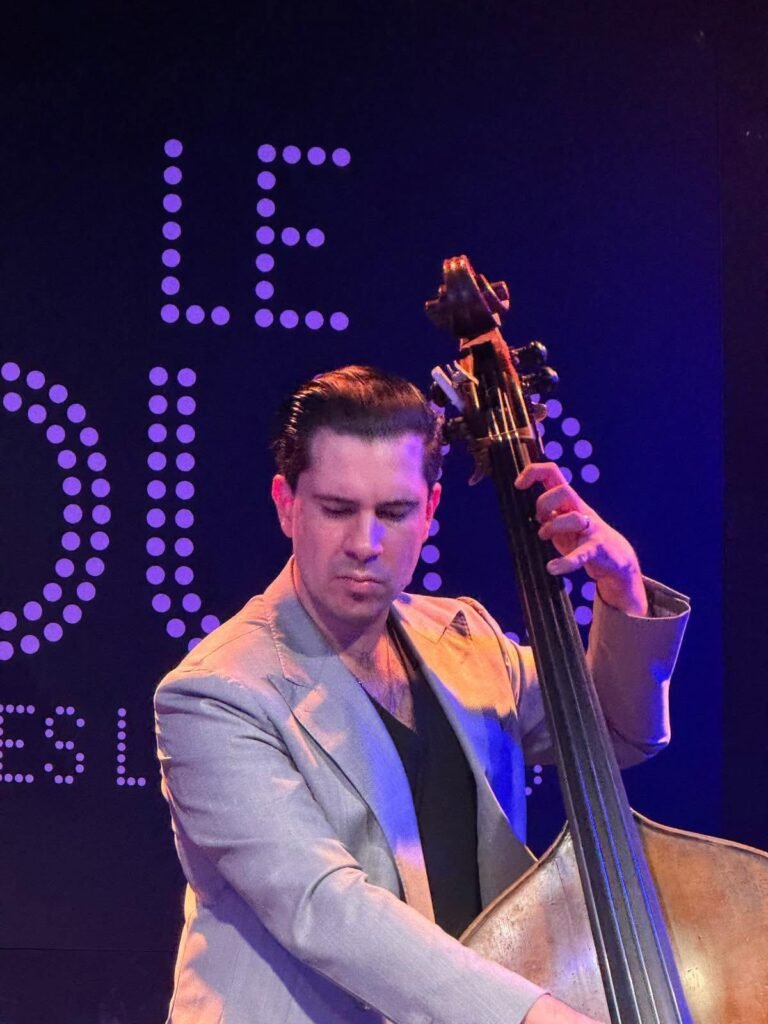
The ensemble brings together the virtuoso contrabassista Matheus Nicolaiewsky, the amazing pianist Henrique Gomide, and the renowned drummer/percussionist Mauro Martins.
This trio presents groove-driven, modern arrangements of works by Edu Lobo, Tom Jobim, Djavan, Hermeto Pascoal, Dominguinhos, and other giants of Brazil’s vast musical landscape.
From samba to baião and maracatu, these rhythms provide the foundation—expanded by tight interplay, Herbie-esque harmonic surprises, and a contemporary improvisational spark that energizes every audience.
Matheus Nicolaiewsky, one of Brazil’s most distinctive young bassists, is known for his close collaborations with Francesca Tandoi, Stochelo Rosenberg, as well as for playing and recording with Kiko Freitas, Peter Bernstein, Ivan Lins, the WDR Big Band, and for his acclaimed debut album with Yotam Silberstein. His deep groove, melodic sensitivity, and contemporary approach to Brazilian rhythm are a core part of the trio’s sound.
Henrique Gomide is a key figure in the Brazilian jazz-scene in Europe, known for his work with Caixa Cubo and collaborations with Toninho Horta, Yamandu Costa, and Guinga. https://www.henriquegomide.com/ https://www.caixacubo.com.br/
Mauro Martins brings decades of international experience, including performances at Montreux, Blue Note New York, and collaborations with Toquinho, Airto Moreira, Phil Collins, Tania Maria, Toninho Horta, and Richard Galliano.
Concert including Pasta, coffee/tea with dessert and limoncello or whisky/grappa €50 pp Reservations via the contact form on this site All welcome from 1700H Pasta 1800H First music set 18.45H
The Dramtune Foundation was established in The Hague in 2009, after its founder, Sandro Bruti, had already spent many years developing a deep passion for traditional music, particularly from Scotland, Ireland and Italy.
Since then, this love of music has been shared wholeheartedly with friends and fellow music lovers, combined with good wine, good whisky and, of course, Italian delicacies from the country of his father, specifically the area around the volcanic Lake Bolsena in northern Lazio.
Over the years, Dramtune has provided a stage for many hundreds of musicians across a wide range of musical styles, from jazz, funky soul, blues and Latin to tango, gypsy, Americana, country and folk rock. It has also featured traditional music from, among others, Scotland, Africa, Mexico, Ireland, Italy, Brittany, Iraq, Turkey, Hungary, Romania and Greece.