What makes The Bull so special is the fact that Potter painted something as ordinary as a bull on such a grand scale – which had never been done before. And despite this large size, he paid great attention to the smallest details, such as the lark in the sky, the sunshine on the meadow, the flies on the bull’s back and the cow’s whiskers. This made the piece the epitome of Dutch naturalistic painting.
After a year and a half of restoration, the largest painting in the Mauritshuis collection, Paulus Potter’s The Bull (1647), was ready for its unveiling. Since March 2024, conservators Abbie Vandivere and Jolijn Schilder have been intensively engaged in scientific research and treatment, from varnish removal to retouching damage. This led to exciting discoveries, but also interesting questions and challenging dilemmas. The goal of the restoration was to return as closely as possible to Potter’s original intention. This proved to be a true journey through time, from alterations made by Potter himself to centuries-old overpainting, damage, and historical additions made by conservators. For the first time in centuries, Potter’s original sky is visible again.
When asked about the greatest challenges, restorers Abbie and Jolijn, cited the following: technically removing later overpainting, as some of this overpainting was already two centuries old and difficult to separate from Potter’s paint. This required extreme care. Ethical dilemmas frequently arose: how far could retouching (restoring or retouching damaged or lost areas of the painting) be carried out without affecting Potter’s work? Furthermore, Potter used pigments in the paint that have faded after 380 years, gradually revealing the underlying layers. During the restoration, each area was assessed to determine whether this “disrupted” the overall image. In the former case, (reversible) “toning” (lightly repainting) was the solution, while in the latter case, the image was left as it is.
Every Friday afternoon at 14:00, the restorers will meet at the Golden Room in the museum for an exclusive Q&A session. Feel free to ask them anything about the art restoration process: Are they ever nervous? What is the most fun thing to do during restoration? And how does it actually work? For more information:
Potter’s bull will remain on display in the publicly accessible restoration studio for another month, and will be back on display in its usual spot in the “Potter Hall” starting at the end of February 2026.
Last year marked the 400th anniversary of Paulus Potter’s birth. January 17, 2026, marks the 372nd anniversary of his death.
Images: Sherika Rooplal-Clappers and Kunstmuseum
Sherika Rooplal-Clappers is a contributing writer for The Hague Online, covering culture, lifestyle, and local events. With a passion for storytelling and international perspectives, she highlights the people, places, and experiences that make The Hague a dynamic city.
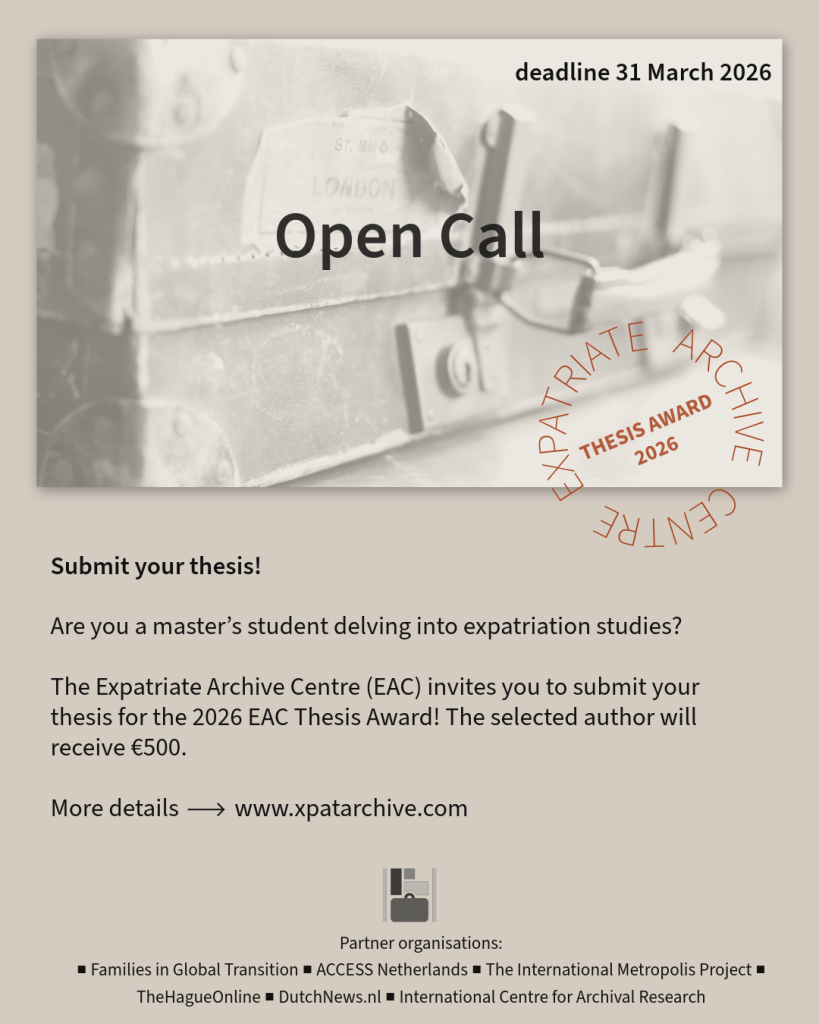
The EAC Master’s Thesis Award celebrates and rewards scholars who produce outstanding master’s theses that help further our understanding of the impact of expatriation on people’s lives.
The Expatriate Archive Centre is now welcoming submissions for the 2026 EAC Thesis Award.
The submission deadline is 31 March 2026.
Candidates must ensure their thesis meets the following criteria:
The winner of the thesis award will receive €500, the executive summary of the thesis will be published online by the EAC and organisations involved in this initiative.
If you would like to know more about the evaluation process, the jurors, how to apply, or our partner organisations, please visit the EAC Thesis Award page. Questions can be sent to welcome@xpatarchive.com.
AWC The Hague is proud to support BriBos as our Charity of the Year, honoring an organization built on compassion, dignity, and human connection. Cancer affects nearly every family, and BriBos offers meaningful support to those facing its challenges, all free of charge.
BriBos was founded by Brigitte Bosman, whose warmth and resilience inspire everyone she meets. Having lived with one lung and experienced cancer herself, Brigitte recognized a gap in care, not in medicine, but in comfort and emotional support. From this insight, BriBos was created to provide the care she once needed and knew others did too.
BriBos focuses on caring for the whole person during cancer treatment. While hospitals address medical needs, many patients face exhaustion, anxiety, and isolation. BriBos helps fill this gap by offering free, non-medical services such as pamper bags, self-care treatments, workshops, and supportive information for patients and families.
Located at HMC Antoniushove Hospital in The Hague, BriBos supports both inpatients and outpatients across the Haaglanden region. Its comfort lounge offers a welcoming space where patients and loved ones can rest, connect, and feel at ease. Visitors are greeted with simple comforts and kind conversation, and team members can accompany patients to appointments when needed.
Run entirely by volunteers, many of whom are cancer survivors, BriBos offers services including massage, skincare, hair and eyebrow care, and touch therapy at no cost. The organization also provides compassionate end-of-life support, creating peaceful spaces centered on comfort and care.
As Charity of the Year, BriBos offers the AWC community a powerful way to give back. Through fundraising initiatives, donation drives, and community events, AWC members have contributed essential supplies, created bilingual brochures, and sewn Heart Pillows and Knuffelkussen, carefully designed to provide comfort after surgery.
Brigitte Bosman shares the story and mission of BriBos during AWC’s Pink High Tea fundraiser.
AWC volunteers come together each month to sew Heart Pillows and Knuffelkussen, providing comfort and support to cancer patients after surgery.
The warm and inviting BriBos lounge, a space many patients and family members describe as feeling like coming home during their hospital stay.
BriBos provides free self-care treatments to support patients experiencing physical discomfort, emotional stress, and isolation during cancer treatment.
Featured image: AWC-board Members of the AWC board gather with BriBos founder Brigitte Bosman in the welcoming BriBos lounge. Pictured from left to right are Jennifer Sturgeon, Hannah Gray, Cathy Van Order, Brigitte Bosman, Freda Sheriff, Erica Frank, Shaina Starr, and Natalie Malis.
To learn more about BriBos or to share with someone who could use their services, visit
The new movie year is here. Enjoy the best stories and the finest extras during the dark days with family, friends, partner…or even enjoy on your own!
January gets off to a great start with a wide selection of top films that will quickly make you forget the winter blues. The month is all about suspense, spectacle, and high emotions: from disaster scenes and devastated landscapes in Greenland: Migration to dark visions of the future and moral dilemmas in the science fiction thriller Mercy. In 28 Years Later: The Bone Temple, a legendary world is reopened, while Send Help and Shelter draw you into merciless survival stories full of intrigue, paranoia, and action.
With surprising, moving films like Rental Family and powerful arthouse titles like Hamnet , January is the perfect month to start the new movie year well.
28 Years Later – Part 2: The Bone Temple @2025 Sony Pictures Releasing (via Universal). All Rights Reserved.
Greenland: Migration– January 8
Five years after a comet has destroyed most of the Earth, John Garrity (Gerard Butler) and his family are forced to leave the safety of their bunker in Greenland. They must once again brave the most extreme weather conditions and embark on a merciless journey across a devastated Europe, searching for a new place to build a safe life.
Greenland Migration @ 2025 All Rights Reserved.
Rental Family – January 8
A lonely, down-on-his-luck American actor (Brendan Fraser) living in Tokyo starts working for a Japanese “family rental” company, playing various stand-in roles in other people’s lives. Along the way, he discovers unexpected happiness within his new blended family.
28 Years Later: The Bone Temple – January 15
The world Danny Boyle and Alex Garland created in 28 Years Later is both expanded and completely turned upside down in 28 Years Later: The Bone Temple . In this new installment of this legendary story, Dr. Kelson (Ralph Fiennes) forms a shocking new friendship that could change the world forever. Spike (Alfie Williams), after meeting Jimmy Crystal (Jack O’Connell), is thrust into a nightmare from which he can’t escape.
Mercy – January 22
In the near future, a detective (Chris Pratt) is on trial for the murder of his wife. He has just 90 minutes to prove his innocence before his fate is determined by the advanced AI judge (Rebecca Ferguson) he himself championed.
Hamnet – January 22
Hamnet is an arthouse film that tells the powerful love story that inspired Shakespeare’s timeless masterpiece, Hamlet. Starring Jessie Buckley (Wicked Little Letters, The Lost Daughter) and Paul Mescal (Gladiator II, Aftersun).
Send Help – January 29
Two colleagues are stranded on a deserted island as the sole survivors of a plane crash. On the island, they must put their old conflicts behind them and work together to survive. But ultimately, their struggle devolves into a disturbing, darkly comic power struggle full of intrigue and survival instinct.
Shelter – January 29
In Scotland, the mysterious Mason (Jason Statham) leads a reclusive life. But when he saves a young girl from drowning during a violent storm, his courageous rescue attracts the attention of violent figures from his past. They launch a relentless manhunt for the duo, resulting in a deadly game of cat and mouse. Starring Jason Statham, Bill Nighy, and Naomi Ackie.
Pathé is the first and largest cinema brand in the Netherlands, founded in Paris in 1896 by true pioneers of film: the Pathé brothers. Their aim was to share the wonderful world of film with as many people as possible. Throughout the Netherlands, Pathé has 30 locations, 253 screens and 1,900 employees. Through its wide range of films, livestreams of opera, sports and gaming, among others, the latest techniques such as IMAX, 4DX, Dolby Cinema and ScreenX, and business events, Pathé creates special and unforgettable cinema stories for all.
Disclaimer& Copyright notice
Pathé is a partner of The Hague Online, and we receive cinema tickets in exchange for sharing monthly updates and links on our website and in our enewsletter. Text is provided by Pathé in Dutch and translated into English by The Hague Online. Images are provided by Pathé. Text and images may not be copied and shared without permission.
Game of Thrones fans, take note! Pathé, in collaboration with HBO Max, has announced that the first two episodes of the new HBO original series “A Knight of the Seven Kingdoms” will be shown exclusively at select Pathé Theaters.
On Thursday, January 15, four days before the series’ official release, fans will have the chance to experience the series on the big screen. These exclusive screenings are available to allClub Pathé members.
Set a century before the events of Game of Thrones , the series follows Ser Duncan the Tall and his squire, Egg, as they travel through Westeros during the Targaryen dynasty. This highly anticipated series immerses fans once again in the world of Westeros, packed with action, humor, and iconic characters.
Collaboration between Pathé and HBO Max
After previous successful screenings like The Last of Us and, more recently, IT: Welcome to Derry, Pathé and HBO Max are returning to the big screen together. Pathé is always looking for special, exclusive content for its viewers.
Pathé has already screened various Game of Thrones content, including the season finale of the spin-off House of the Dragon in 2024.andthe final episode of the original series in 2019, which was a huge success.
The first two episodes of A Knight of the Seven Kingdoms can be seen at Pathé Spuimarkt in The Hague.
Pathé is the first and largest cinema brand in the Netherlands, founded in Paris in 1896 by true pioneers of film: the Pathé brothers. Their aim was to share the wonderful world of film with as many people as possible. Throughout the Netherlands, Pathé has 30 locations, 253 screens and 1,900 employees. Through its wide range of films, livestreams of opera, sports and gaming, among others, the latest techniques such as IMAX, 4DX, Dolby Cinema and ScreenX, and business events, Pathé creates special and unforgettable cinema stories for all.
Disclaimer& Copyright notice
Pathé is a partner of The Hague Online, and we receive cinema tickets in exchange for sharing monthly updates and links on our website and in our enewsletter. Text is provided by Pathé in Dutch and translated into English by The Hague Online. Images are provided by Pathé. Text and images may not be copied and shared without permission.
For the past two decades, the Christmas period in The Hague has been closely linked to dance, with De Dutch Don’t Dance Division building a festive tradition that has returned year after year in different forms. What began as a series of winter and Christmas productions has grown into a recognisable part of the city’s cultural calendar, now firmly anchored at Amare.
Since the mid-2000s, De Dutch Don’t Dance Division has presented a wide range of Christmas and winter performances, including original productions and reinterpretations of well-known stories. Over the years, titles such as A Christmas Carol, Alice in Winter Wonderland and De Haagse Notenkraker have helped shape a festive programme that appeals to families, regular theatre-goers and new audiences alike. Together, these productions mark twenty years of Christmas dance in The Hague.
This anniversary year is accompanied by an exhibition at Amare reflecting on two decades of Christmas productions by De Dutch Don’t Dance Division. The exhibition was officially opened by Jan van Zanen, underlining the significance of the milestone not only for the company but also for the city’s cultural life. Through costumes, props, visual material and personal stories, the exhibition shows how these festive performances evolved over time and became a fixed element of The Hague’s end-of-year celebrations. The retrospective highlights artistic development alongside the many people and communities involved both on and off stage.
A defining feature of the Christmas productions has been their scale and inclusivity. Year after year, professional dancers, young talent and amateur performers have shared the stage, creating broad city productions that reflect the diversity of The Hague itself. This approach has enabled generations of dancers to take part, while audiences return annually as part of their own holiday traditions.
As part of this anniversary season, De Haagse Notenkraker returned to Amare for a final run in its current form. First premiered in 2006, this production grew into one of the company’s most recognisable Christmas performances. From 25 to 30 December, eight performances will be staged at Amare, performed by two casts with a combined total of 112 dancers. Ahead of the run, more than 90 percent of tickets had already been sold, highlighting the enduring popularity of the production and its place within the wider Christmas tradition.
While this chapter comes to a close, the anniversary also looks ahead. After twenty years of festive productions, De Dutch Don’t Dance Division continues to develop new ideas and formats. With a strong foundation built on creativity, community involvement and continuity, expectations are high for how Christmas dance at Amare will continue to evolve in the years to come.