Commissioned by the Municipality of The Hague, Erasmus University has conducted research into the causes of litter nuisance in the city. The study shows that waste behavior is strongly influenced by daily routines, living conditions, social relationships, and how residents perceive the municipality’s efforts. The conclusions align closely with the measures in the current Waste Action Plan 2023–2026 and simultaneously provide direction for further strengthening the approach to waste management.
Alderman Arjen Kapteijns (Raw Materials) reacts positively to the results: “ This research confirms that we are moving in the right direction in The Hague. We have already taken significant steps in recent years, but the insights from Erasmus University help us to align even better with the daily lives of residents. Due to the growth of the city, the strong increase in online orders, and changing consumption patterns, simply more and more waste is being generated. We are on the right track, but this requires sustained effort. That is why we continue to invest in an approach that works for the city and its residents. ”
Key insights from the research
The researchers show that waste nuisance is not isolated from broader social and physical conditions. Some key conclusions:
Space and rhythm play a major role: limited space in the house, full containers, or the impression that containers are full lead to additional waste being placed more quickly. If a garbage bag is already lying next to a container or one of the containers is jammed, it creates the impression that everything is full.
Context determines behavior : residents are more likely to dispose of waste incorrectly when they are in a hurry, have little space, or see no alternative. For example, someone wants to catch the tram, has limited space in their home, sees that the container is full, and decides that a ‘non-dirty’ item can safely be left outside for a while.
Socio-economic pressures such as stress, temporary occupancy, and overcrowding increase the likelihood of litter nuisance. Residents sometimes think that their neighborhood receives less attention, while in fact, extra cleaning is often carried out there.
Knowledge and language barriers cause misunderstandings regarding waste regulations, especially among newcomers and residents without a local network.
Social relationships in the neighborhood influence waste disposal behavior: less mutual contact means less informal correction.
Enforcement alone does not work because it does not resolve the structural causes of waste nuisance. An interplay of the aforementioned causes has a greater influence on behavior.
Trust and feedback are crucial: if reports are not visibly addressed, reporting fatigue sets in.
Municipality continues set course and expands
The Municipal Executive views the study as an important confirmation of the course set in the Waste Action Plan. Many recommendations align directly with measures already being implemented or soon to be expanded. At the same time, the municipality is using the new insights to further deepen and broaden the approach.
Five-point plan: how The Hague will proceed
Based on the research, the municipality is intensifying and broadening its approach on five points. The municipality is bundling the recommendations into a broad strengthening of the existing approach. In 2026, area-based working will be expanded with additional project managers for waste and cleanliness, enabling better tailored solutions per neighborhood. Residents and local organizations will receive more scope and support through neighborhood budgets or micro-subsidies, as well as additional appreciation events for volunteers. Information provision will be intensified with more waste advisors, clearer multilingual communication, and faster feedback on reports. Additionally, there will be a stronger focus on reuse, including by linking more repair cafés and recycling initiatives to cleanup days. Finally, collection will be further increased: containers will be emptied more frequently, particularly on weekends, and operations will be better aligned with the rhythm of the city.
Outlook
The municipality is incorporating the recommendations into the successor to the Waste Action Plan. In doing so, explicit attention is being paid to the connection with other themes such as poverty, housing, and well-being, because, according to the research, waste nuisance is closely intertwined with broader living conditions. Waste nuisance cannot be solved with just extra containers or increased enforcement. It is about living conditions, trust, and cooperation. This research helps us maintain that broad perspective.
The Hague City Hall is undergoing a major sustainable makeover. After more than 30 years, the roofing is due for replacement, and the municipality is seizing this opportunity to make the building greener and more sustainable. In total, 5,200 m² of green roof is being installed across the City Hall, the Central Library, and the Forum Building. Work has already commenced. Alderman Robert Barker (Environment) kicked off the installation of the green roof on the IJspaleis. The new green oasis on the roof of the City Hall will be ready in May 2026.
Artist impression of the new roof
The new roofing not only addresses maintenance: the city hall is also getting green roofs with water storage, extra insulation, and solar panels. The greening helps to reduce heat stress in the city centre and contributes to the city’s climate goals. The green roof temporarily retains rainwater and drains it slowly, relieving the sewer system during heavy downpours. Alderman Barker: ‘ With this roof in this prominent location, we also want to inspire people. Many roofs in The Hague are waiting to be greened! ‘
Urban nature on the roof
A special piece of urban nature is coming to the roof between City Hall and the Forum Building. In addition to planting, a feeding bowl, water bowl, sand bowl, and an insect hotel will be installed here to stimulate biodiversity. Moreover, this roof is clearly visible from both buildings, allowing visitors and employees to observe the new green oasis. Alderman Robert Barker (Environment) is proud of this special step: ‘City Hall is an icon in our city. By making it green, we are not only making the building more sustainable but also better prepared for extreme heat and rain. With these interventions, we show that The Hague takes its role model seriously and that every square meter of greenery counts .
Text: Gemeente Den Haag
Translation to English: The Hague Online
Photographer Michel Mees (City Hall roof photos 1 and 2)
The Koningin Julianaplein, directly in front of the central station, is set for a complete green transformation with 28 new trees, a new pavilion with terraces, and much more space for pedestrians and cyclists. These plans have been presented to The Hague city council by the municipal executive.
Klaas Verschuure, alderman for urban development: “The square is a unique gateway to the city and lies directly opposite the centuries-old Haagse Bos. At the moment, as a construction site, it is still difficult to imagine, but it will soon become a green calling card with which we warmly welcome residents of The Hague and visitors.”
The new square will become significantly greener, with more than 1,790 square metres of greenery. Special trees and plant species will be selected so the area remains attractive throughout the year.
Queen Juliana, the namesake of the square, will have her statue returned to a prominent place on the square. The well-known zebra clock will also return along the Rijnstraat.
Residents, entrepreneurs and other stakeholders have helped shape the design of the square and were able to influence the final plans. Thanks to their input, the square will become more accessible for people with disabilities and will include new lighting.
If the city council approves the plans, construction of the new Koningin Julianaplein could begin in 2027.
Text & image: Gemeente Den Haag Translation: The Hague Online
The Municipality of The Hague and the Haagse Nachtraad Foundation have signed an agreement to further strengthen The Hague’s nightlife. With this agreement, both parties formalize how they will collaborate on an accessible, safe, and future-oriented nightlife. This year, the municipality is also providing financial support to the foundation for the deployment of the Night Mayor and the activities of the Night Council that contribute to shared goals.
With these agreements, the Municipality and the Night Council are implementing the Night Vision, which was adopted in November 2024. The goal of this vision is to further develop The Hague’s nightlife, with a focus on safety, inclusion, and more space for night culture. As part of the agreement, the Municipality is making dedicated contact persons available within various departments, and periodic consultations will take place with the Night Mayor. The contribution of €60,000 supports the efforts of the Night Mayor and the activities of the Night Council within this collaboration. The subsidy is not intended for organizing club nights or other night programs; the foundation will continue to seek its own funding for this purpose.
A serious place for the night
The municipality views the Night Mayor as an important dialogue partner who acts as a link between the night sector and municipal decision-making. The Hague’s Night Mayor, Lotte Ottevanger, is pleased with the collaboration: “The night deserves a serious place in urban policy. With this covenant, The Hague shows that night culture matters. Together, we are working towards a night where everyone is welcome, gets home safely, and where the visitor, the creator, and the entrepreneur feel heard.”
Alderwoman Saskia Bruines (Culture and Economic Development): “With this covenant, we are anchoring the collaboration that was so essential in the creation of the Night Vision. The Night Council and the Night Mayor are helping us make The Hague’s nightlife stronger, safer, and more inclusive. This ensures that The Hague remains an attractive city 365 days and nights.”
Joint step
The Hague Night Council Foundation was established in June 2025 and consists of young representatives from all corners of The Hague’s nightlife. From organizers and artists to hospitality entrepreneurs and nocturnal innovators: together, they give a voice to what lives, dances, and dreams in the city. The Council advises and supports Night Mayor Lotte Ottevanger and acts as a sparring partner for municipal policy. Meanwhile, the Night Council is also actively working on other initiatives that strengthen the position of The Hague’s nightlife.
The Hague’s nightlife plays an important role in social cohesion, creativity, and talent development in the city, and contributes to the attractiveness of The Hague as a place to live and a student. With this collaboration, the Municipality and the Night Council are taking a joint step towards a future-proof nightlife sector.
Caption: Alderman Saskia Bruines (Culture and Economic Development) and The Hague Night Mayor Lotte Ottevanger, surrounded by members of The Hague Night Council.
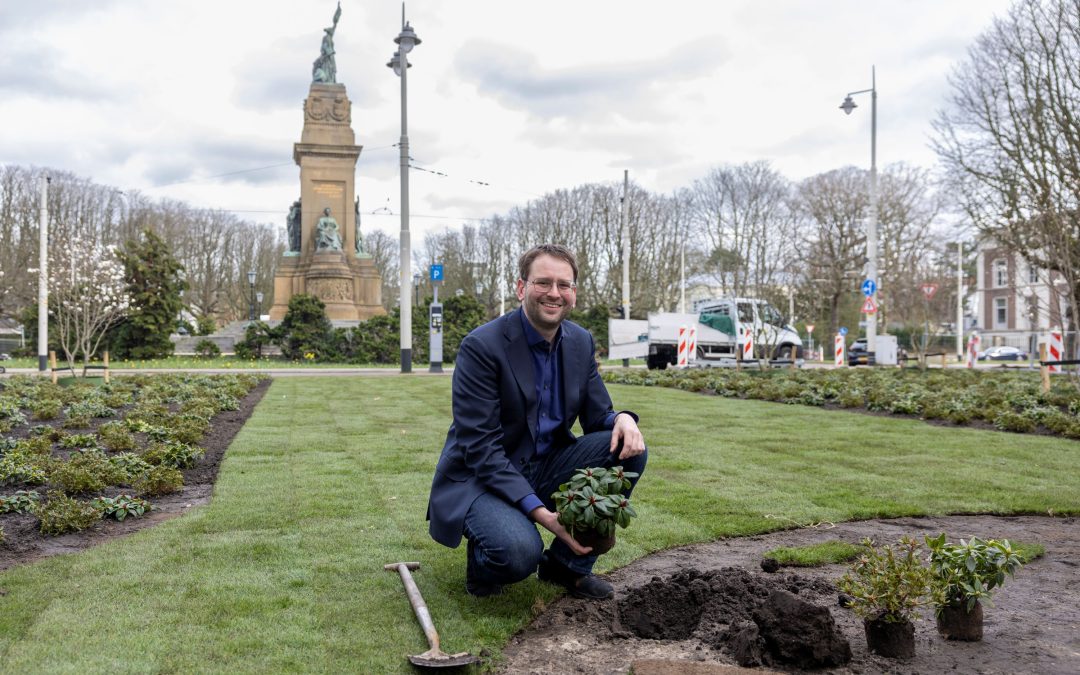
The Municipality of The Hague has started making Plein 1813 greener. By removing paving stones and parking spaces, there will be more room on the historic square for trees, shrubs, and other greenery. This reinforces the monumental character of the square and creates a more pleasant, climate-resilient living environment. Alderman Robert Barker (Public Space, Animal Welfare, Environment) symbolically planted a number of new plants today.
Plein 1813 is best known for the National Monument commemorating the founding of the Kingdom of the Netherlands in 1813. The square forms an important historical and cultural anchor point in the city. As early as 2018, a plan was in place to green the square, with an emphasis on the immediate surroundings of the monument. In the current implementation, that plan is being expanded: the triangles on the inner side of the square are now also being landscaped with greenery. In total, 2,500 m² of green space will be added.
Rich history honored
Alderman Barker emphasizes the importance of this step: “Plein 1813 is a place with a rich history. By adding greenery here, we not only make the square more beautiful but also future-proof. Less stone and more greenery helps us make the city cooler, healthier, and more livable. This square shows how we are making The Hague greener, step by step.”
Approach to urbanized neighborhoods
The greening of Plein 1813 is part of a broader approach to making paved neighborhoods in The Hague greener. More greenery contributes to biodiversity, better water retention during heavy rainfall, and a more pleasant living environment for residents and visitors.
The Hague City Council has adopted the “Housing Supply Memorandum” at the proposal of the Municipal Executive. This significantly relaxes the rules for structural division, room occupancy, and landlady rentals, effective April 1st. According to Alderman for Housing Co Engberts, this is an important step towards creating more affordable housing more quickly. “This is good news for every resident of The Hague who urgently needs a home,” he added.
The new rules align with the recent call from Chief Government Architect Francesco Veenstra, who emphasized that splitting houses creates additional housing much faster than new construction and that municipalities must provide the necessary support. The Housing Vision 2040 already included the ambition to facilitate splitting houses. The Housing Stock Memorandum now implements this.
Structural splitting made easier
In many more neighborhoods than before, it will once again be possible to divide existing homes into two or more independent dwellings. This had been rarely permitted since 2019. Starting April 1st, this will be possible again, provided the neighborhood’s quality of life is maintained. Additional restrictions will also be lifted or relaxed. For example, a new divided dwelling may be 5 m² smaller than before.
More space for room occupancy
The Hague is expanding the options for room rentals, making it easier for young people, among others, to access the housing market. A conversion permit remains required for rentals to more than two people, but this will soon be permitted in many more neighborhoods. The maximum percentage of homes in a neighborhood eligible for this permit will increase from 5 to 10 percent. Here too, the quality of life must be sufficient.
Landlord rentals, where the landlord lives in the property, are being further relaxed. From April 1st, rentals to more than one person are permitted without a permit, provided these persons belong to the same household or if they are two single-person households. While no permit is required, a notification requirement does apply.
‘Lives in motion again’
Alderman Engberts emphasizes that the measures are intended to stimulate more movement in the housing market. “People in their twenties are currently forced to stay at home, homeless people are spending too much time in emergency shelters, and seniors are finding too few suitable smaller homes. This expansion allows us to quickly create additional housing options that meet these needs. This helps get lives moving again and stimulate the flow of new homes.”