
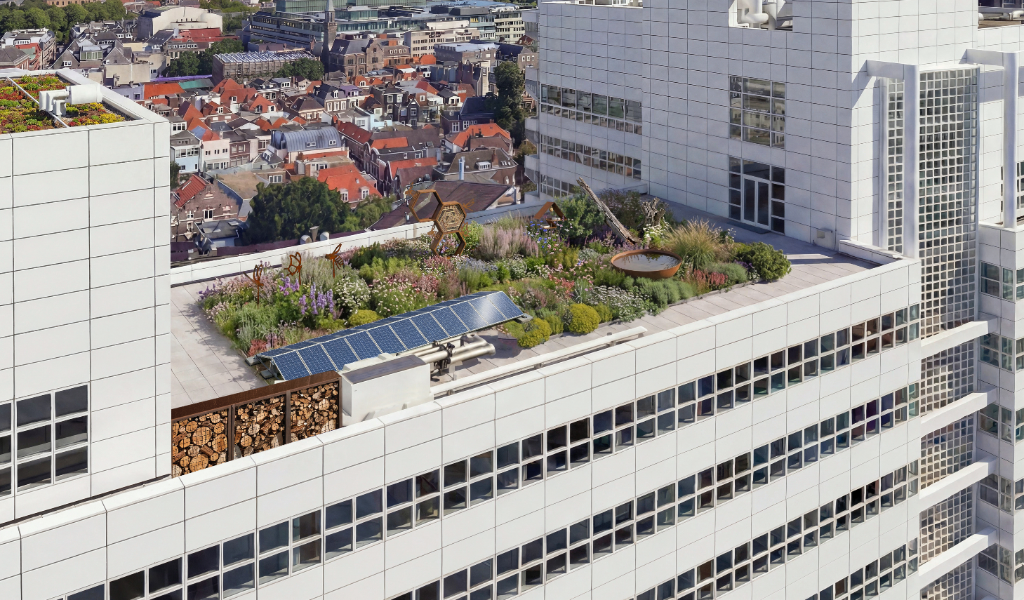
The Hague has a lot of rooftop space that is not yet being utilized for purposes such as greenery, rainwater harvesting, or solar panels. During The Hague’s rooftop festival, Uit je Dak, visitors can discover just what is possible on those roofs. At six unique locations in the city, initiators demonstrate how rooftops contribute to a more pleasant, greener, and better-prepared city .
During Uit je Dak, six rooftops in The Hague open their doors to the public. Three locations are participating for the first time this year: Leiden University, Centrum Laakhavens, and Living Lab Binckhaven.
On the roof of Leiden University, visitors discover how green roofs contribute to more biodiversity in the city.
At Centrum Laakhavens, various applications of green roofs are showcased, including innovative systems that make buildings more resilient to heat and extreme rainfall. Living Lab Binckhaven demonstrates how smart technologies, a rooftop flower meadow, and innovative solutions can contribute to a green city. Well-known participants such as EnergieKas Helena, De Bijenkorf, and the Ministry of the Navy are also taking part. Visitors can participate in guided tours, activities, and inspiration sessions here regarding the possibilities of The Hague’s rooftops.
Alderwoman Isabelle Broeders (Public Space): “The most beautiful green space in The Hague is sometimes not on the ground, but above our heads. There is space on roofs that we can utilize more intelligently. By doing so, we make the city more pleasant, limit the nuisance caused by heat and rain, and get more out of existing buildings. That is not only sensible, but also an efficient way to make the city future-proof. With City Hall, we are setting a good example ourselves and showing how many opportunities lie on The Hague’s rooftops.”
The municipality sets a good example itself.
The way in which the municipality utilises its own roof space is improving. Over 5,200 square meters of green roof are being installed on City Hall, the Central Library, and the Forum Building. The roofs retain rainwater, provide cooling, and offer space for plants and animals. In doing so, the municipality demonstrates the opportunities available on the many roofs in The Hague.
In The Hague, approximately 35 percent of roofs are now utilized for purposes such as solar panels, green roofs, or rainwater harvesting. Uit je Dak demonstrates that there are still many opportunities. From energy conservation and rainwater harvesting to more greenery in the neighborhood: The Hague’s roofs often offer more possibilities than are visible at first glance.
More information and the full program can be found at denhaag.nl/uitjedak .